This article may contain affiliate links. If you buy through them, Healthy Habits Everyday may earn a small commission at no extra cost to you. Learn more.
For about two years, every work trip did the same thing to my morning routine. It did not just get shorter, it disappeared entirely by day two, and I would come home annoyed at myself for losing a month of consistency in a four day trip. I assumed the problem was discipline. I now think the problem was that I never built a version of the routine that was designed to travel. I built one version, for one room, and expected it to work everywhere.
The home version depended on things a hotel room does not have. A specific chair. A kitchen counter at the right height. A door I could close on a dog who wanted attention at 6 a.m. When even two of those were missing, I would tell myself I would just skip today and get back to it tomorrow. Tomorrow had the same problem, because I had not changed anything about how I was approaching it.
The routine was never the problem, the dependencies were
When I actually broke down what my morning routine consisted of, most of it was not the core action. It was staging. Reading for fifteen minutes required my specific chair and my specific mug. Stretching required a mat I did not pack. Even something as simple as drinking water first thing required a glass I kept by the sink, which sounds trivial until you notice you have quietly made a habit depend on an object instead of an action.
None of that is a character flaw. It is just how habits form at home. You use what is around you, and the environment becomes part of the habit without you deciding that on purpose. The issue only shows up when the environment changes and the habit has nowhere to attach itself.
A habit that only works in one room is not a habit yet. It is a room with a habit-shaped routine happening inside it.
What I stripped it down to
I went through each piece of my morning routine and asked a blunt question: does this need my house, or does it need me. Reading needed me and a book, not the chair. Stretching needed floor space, not a mat, at least for a stripped down version. Drinking water needed water, which every hotel room on earth has access to within thirty seconds.
What I ended up with was a much smaller routine that traveled without complaint:
- Water first, before coffee, using whatever cup is in the room
- Five minutes of stretching on the floor, no mat required
- Ten minutes of reading on my phone or a paperback, no specific chair
That is roughly a third of what I do at home. I used to think that was a failure, a diminished version of the real thing. I do not think that anymore. The travel version is not a lesser routine. It is the load bearing part of the routine, the piece that actually does the work, with all the extra scaffolding removed.
The mistake I kept making before this
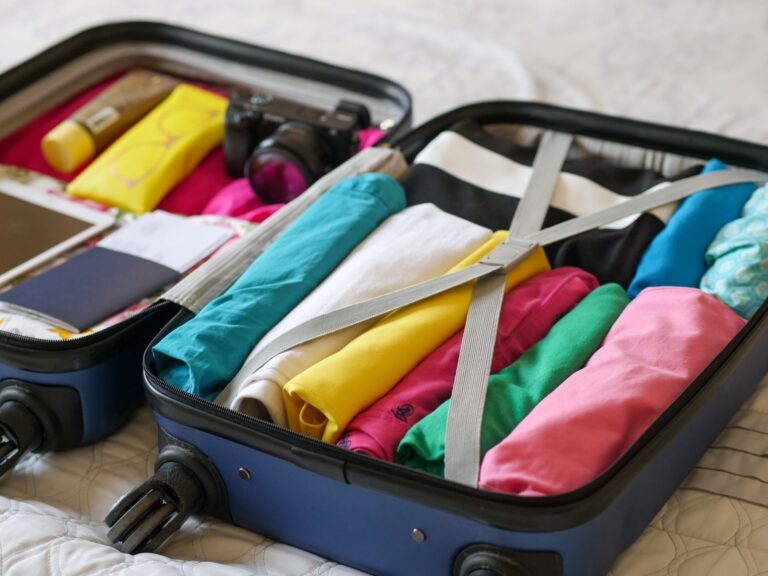
For a long time I tried to recreate the full home routine in hotel rooms, which meant packing a yoga mat, a specific brand of tea, and a travel journal that looked suspiciously like my home journal. This is exhausting and it fails in a specific way. You either get it mostly right, which takes real effort and luggage space, or you get it a little bit wrong, and a little bit wrong feels like total failure when you are attached to an exact version of a routine.
The version that works when your environment changes is smaller by design, not smaller by accident. You decide in advance what the minimum is, before you are standing in a hotel room at 6:45 a.m. deciding on the fly. Deciding on the fly is where routines go to die, because tired brains default to the easiest option, and the easiest option is almost always doing nothing.
Why the hotel version matters more than the home version
I used to think the home routine was the real one and the travel routine was a compromise. I now think it is the other way around. The stripped down version is the actual habit. Everything else, the chair, the mug, the mat, was decoration that made the home version feel more complete without making it more durable.
This matters because most people do not travel constantly, but almost everyone has weeks where the environment changes without warning. A sick kid means no gym. A visiting relative means no quiet morning. A broken dishwasher means the kitchen counter is covered in dishes instead of clear for your usual setup. If your habit only exists in the ideal version of your environment, it is fragile in exactly the weeks life gets less predictable, which tend to be the weeks you need the habit most.
How I test whether a habit will survive a disruption
Before I trust a new habit, I now ask myself what the version would look like with none of the props. Not a worse version, a stripped one. If I cannot answer that question, I take it as a sign the habit is more attached to my environment than to me, and I try to fix that before it gets tested by an actual trip or an actual bad week.
This is not about being able to do everything anywhere with zero setup. Some things genuinely need specific equipment and that is fine. It is about being honest with yourself about which parts of a routine are the actual habit and which parts are furniture. Furniture is nice. It should not be load bearing.
What changed after I did this
The most noticeable thing is that I do not lose momentum on trips anymore, not because I am more disciplined, but because there is less to lose. A three item routine has fewer points of failure than an eight item one. I also come home from trips without the usual guilt lap, the few days of feeling behind before I get back to normal, because the travel version was never fully off, it was just running at a smaller scale.
If you travel for work, or your schedule gets disrupted by things outside your control, it might be worth going through your own morning routine and asking which parts are the habit and which parts are the room. You may find, like I did, that the room was doing more work than you thought, and the habit itself is smaller and sturdier than you gave it credit for.
If disruptions to your routine are tied to something more than logistics, like ongoing sleep trouble or anxiety around travel itself, that is worth bringing to a doctor rather than trying to habit-hack your way through it.